
I bridge the gap between clinical excellence and organizational impact — building programs, shaping policy, and expanding access to care for the communities that need it most.

Sabrina
Shih
Shih
Hi, I'm Sabrina.
I'm a Licensed Clinical Social Worker and currently the Director of Social Services at Mount Sinai Hospital's Eating and Weight Disorders Program, one of the nation's leading specialized eating disorder centers.
My work merges clinical care and operational strategy. I lead interdisciplinary teams, design scalable programs, and develop evidence-based protocols that improve how healthcare systems deliver care — especially to underserved and culturally diverse populations. Using my foundation in direct clinical practice, I bridge the gap between high-level policy and frontline reality by integrating digital health and ensuring protocols work in practice.
My work is driven by a commitment to health equity and dismantling systemic barriers in healthcare. Beyond operations, I advocate for public health policy and provide clinical consultation and training for organizations across New York.
A few things I care about deeply: health equity, culturally competent care, finding better, more human ways to build healthcare systems that scale, and all things cheap eats + miniatures.
What
I Do
I Do
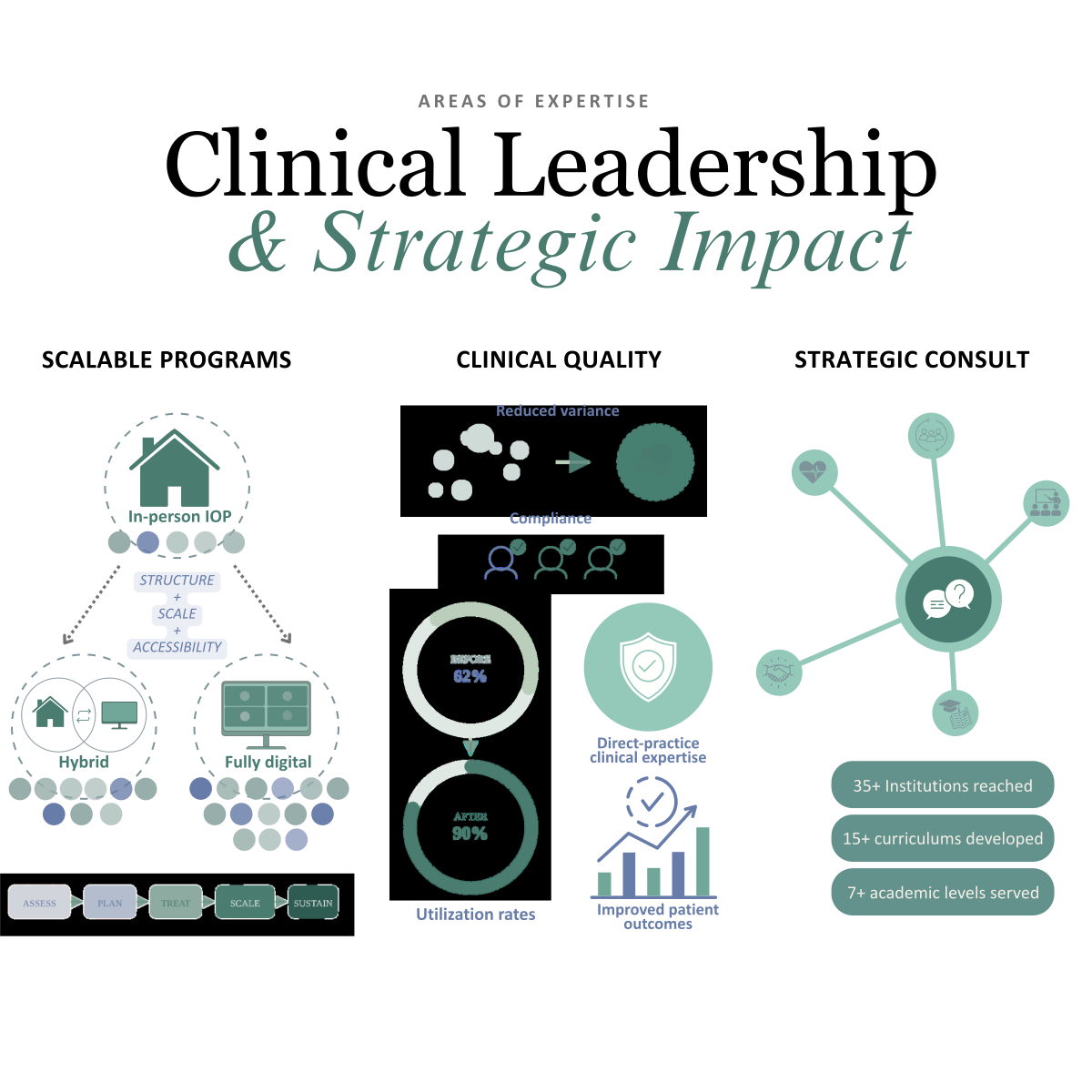
Areas of Expertise
Clinical Leadership & Program Development
I direct interdisciplinary clinical teams and oversee the full lifecycle of program development. From delivering frontline therapeutic excellence to building operational infrastructure that keeps programs running at scale, I have helped build mental health programs to expand access to care while maintaining clinical acuity and excellence.
Healthcare Operations & Quality Management
I’m experienced in designing workflows, performance metrics, and clinical quality systems that improve both patient outcomes and team efficiency. I understand how to translate complex clinical insight into measurable operational strategy. This includes the development and trouble-shooting of virtual care programs, where I ensure that digital delivery maintains clinical integrity while still optimizing team effectiveness, stakeholder alignment, and exceptional patient care. I am expertly skilled at helping build high-growth, large-scale healthcare infrastructures through ensuring consistent utilization management for efficiency, quality assurance to reduce variance, and ahead-of-curve transitions to the most cutting-edge, leading treatment modalities.
Policy & Advocacy
I leverage clinical data to influence systemic change at the federal level. By developing research-based policy analyses and presenting clinical evidence to legislative leaders in succinct and impactful ways, I work to shape public health outcomes. My contributions include federal advocacy efforts for significant mental health legislation, such as H.R. 2625, aimed at expanding access to specialized care. My policy work includes advocating for increased federal spending for eating disorder research by providing qualitative and quantitative research that synthesizes the lived experiences of those struggling with eating disorders with measurable metrics demonstrating, for example, the impact of improved outcomes with clinics that implement novel research.
Consulting & Training
I consult with academic institutions, healthcare organizations, and community groups on various mental health related issues, such as, eating disorder prevention in schools, mental health in the workplace, equitable care delivery, and behavioural health workshops. Beyond individual expert consultation, I lead workforce development initiatives: training clinicians, medical students, educators, and other healthcare leaders to identify and address complex mental health challenges within their specific communities.
Outreach
Impact
Impact
Speaking & Workshops
I’m a frequent speaker, educator, and workshop facilitator on eating disorders, adolescent mental health, body image, and clinical care — across schools, hospitals, and professional organizations.
Available for speaking engagements, staff training, workshop facilitation, and program development. Get in touch to discuss.
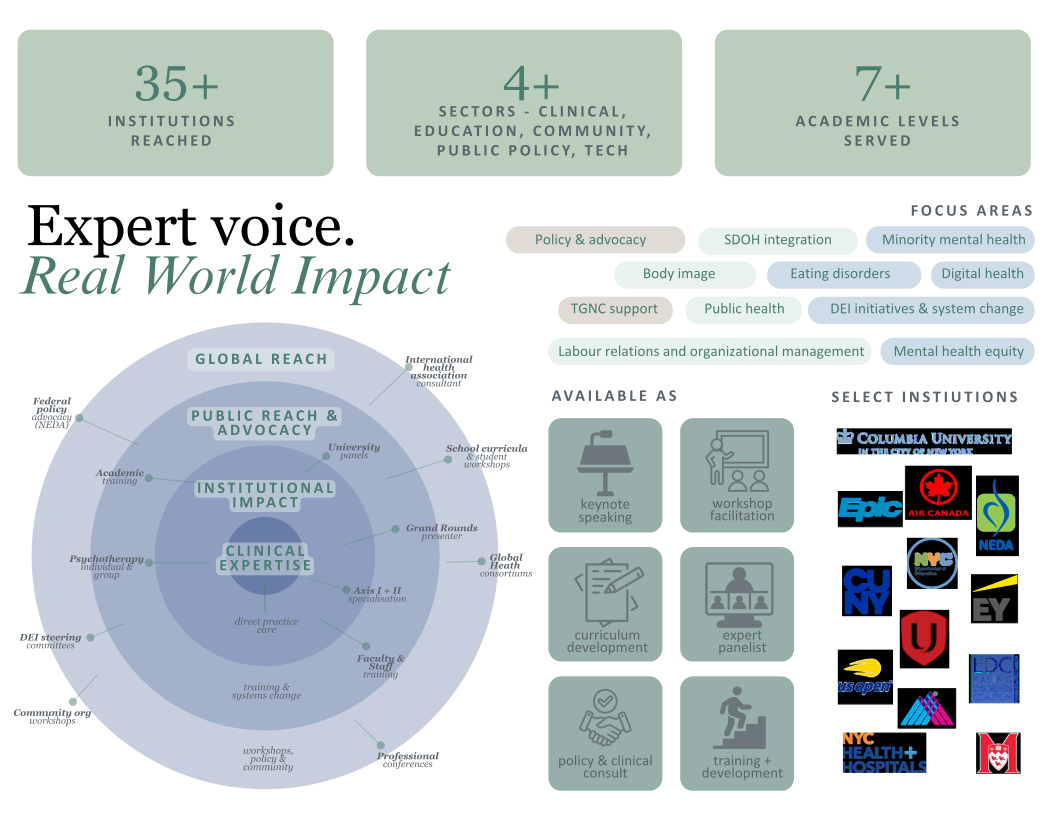
Hospitals & Clinical Settings
- Mount Sinai Hospital Department of Social Work — Grand Rounds presenter
- Mount Sinai Hospital Pediatrics and Psychiatry — Teaching Pediatric Residents & Fellows
- Mount Sinai Hospital Adolescent Health Center — Transgender & Gender Non-Conforming (TGNC) Support Group
- Mount Sinai Hospital Gynecologic Oncology Support Program — Navigating Body Image Through Survivorship
- Mount Sinai Hospital Department of Psychiatry — Diversity, Equity, Inclusion Steering Committee
- NYC Health + Hospitals — Diversity, Equity, Inclusion in the Mental Health Space
- Community Health Network — Resident training
- The Douglas Mental Health University Institute — Eating disorder curriculum consultant
- Montreal General Hospital — Volunteer training and consultant on eating disorder initiatives
Schools & Educational Institutions
- The Hewitt School —
- Student workshops Grades 6, 7, 8, 9, 10, 11, 12
- Faculty training
- Parent workshop
- Grace Church School —
- Student programming Grades 11, Grades 12
- The Brearley School —
- Curriculum development & parent workshop
- New York City Department of Education — Mental Health & Hygiene Curriculum building
- New York City Department of Education — Eating disorder prevention workshop
- CUNY (The City of New York) — Health fair programming
- Industrial Relations Conference 2015, 2016, 2017, 2018 — Organizer & speaker
- Empower McGill - Disabilities inclusion in the Workplace — Speaker
Community & Professional Organizations
- Columbia University School of Social Work — Alumni career panel
- Columbia University School of Social Work — Minority Mental Health workshop
- Columbia University Mental Health Caucus — Intersectional Health Care
- National Eating Disorders Association — Annual advocacy Day & federal policy presentations
- New York Clinical Association —
- Behavioural health training: Navigating Complex Eating Disorder Care
- Caregiver support team workshop
- Mindful Eating Project — Presenter
- Healthcare Breakthroughs Auxiliary Board — Speaker
- Unifor Labour Relations Conference: Mental Health in the Workspace — Panelist
- RBC Royal Bank: Inclusion in the Private Sector — Speaker & Consultant
- Ernst & Young EY Employee Mental Health — Speaker & Consultant
Expertise
By the numbers
A snapshot of impact.
Clinical excellence
470+
Patient caseload managed across outpatient, intensive programming, and virtual modalities as SME
Axis I + II (esp. eating disorders, anxiety, mood disorders, and personality disorders)
Clinical excellence
13+
Evidence-based modalities delivered and supervised
CBT, CBT-E, DBT, ACT, FBT, IE, AFT, CBT-AR, Motivational Interviewing, Exposure Therapy (incl. ERP), IPT, Schema Therapy, Behavioural Activation
Clinical excellence
5
Escalation-of-care protocols designed and implemented
Tiered risk pathways from outpatient to inpatient, eating disorder standardized protocol, effective step-level care escalation
Clinical excellence
100%
Compliance rate across quality audits and accreditation reviews
Joint Commission, state regulatory, and internal clinical standards; data integrity & governance refined
Strategy & operations
3
Clinical programs built from zero to fully operational
Various successful transitioning from pilot to full-scale integration across a network serving 5 NYC boroughs: incl. virtual care expansion, intensive program for high-risk patients
Strategy & operations
60%
Reduction in intake-to-treatment wait time through workflow redesign
Mapped end-to-end patient journey, design + embed behavioral health protocols into existing EHR workflows
Strategy & operations
9+
Skills used for lean process improvement, operational efficiency, performance metrics + KPI defined and monitored
Creation and implementation of SOPs, validation protocols for data integrity, capacity management
Strategy & operations
93%
Conversion Rate Optimization leading to revenue-generating program capacity growth
Consistent high utilization, top patient retention, improved clinical yield enhancement
Growth & talent development
55+
Clinicians, students, and staff trained or supervised
MSW students, medical residents, early-career therapists, interdisciplinary staff, mentorship
Growth & talent development
38
Workshops and training programs designed and delivered
ED prevention, cultural competency, clinical risk, trauma-informed care, minority mental health
Growth & talent development
15+
Curriculum modules built for ongoing development
Onboarding tracks, continuing education, and competency assessments; academic and training curriculums
Growth & talent development
3
Federal legislative advocacy campaign co-led
H.R. 2625 — expanding access to specialized eating disorder care, H.R.2495 — increased coverage for nutrition services, NYSB S.3101 — mental health parity
Impact & outcomes
97%
Improvement in patient-reported outcome measures
Pre/post treatment scores across standardized clinical assessments
Impact & outcomes
88%
Increase in program utilization after operational redesign
Referral conversion, reduced treatment access disparities within underserved populations, decreased median wait time from initial referral to diagnostic assessment
Impact & outcomes
5+
Data platforms and tech fluency used for clinical and operational decisions
EHR (Epic), CRM (i.e: Salesforce), Tableau, PeerPlace, Excel (advanced), Google Suite, CRM, Redcap, MS Project
Impact & outcomes
32
Stakeholder presentations delivered to leadership and partners
Cross-functional planning sessions, incl. initiatives to increase value-based care success
My
Approach
Approach
How I work
I came into this work from the receiving end: turned away from care for not being “sick enough,” raised by a mother translating treatment pamphlets at the dinner table because no provider worked in Mandarin. It’s why I build the way I do.
People first, expertise second. I’m not the expert in my patient’s life — they are. My job is to show up with rigor and humility, meet people where they actually live and treat their individual social determinants of health with concrete, actionable support as clinical interventions, because they are. Care doesn’t work if the rest of someone’s life isn’t working.
The system is usually the problem. When care breaks down, I start by asking where the pathway failed and not who failed it. That’s the lens behind the escalation protocols, SDOH digitization, and digital health quality assurance that is reflected both in my work. It’s also why I keep pushing for prevention, upstream (oftentimes not glamorous!) as the highest-leverage work our field chronically under-invests in.
Equity is structural, not decorative. Racism, class, immigration status, and proximity to whiteness shape who gets care and who shoulders the blame for poor outcomes. Culturally competent care isn’t a comprehension of language but about rather, about understanding the value of culture as each person holds it, and making concrete choices around it. It’s about naming out loud the unjust systems they’re navigating while still putting them in the driver’s seat of their own health.
Digital health has to earn the word “clinical.” Scale is not a substitute for oversight. If a product touches a person in need, it has to have real escalation pathways, real clinical accountability, and a team willing to slow down when a dashboard can’t tell them what they need to know.
Every person deserves to be seen, heard, and valued. That’s the whole job.
Featured
Work
Work
Get In
Touch
Touch